

Wool Mattress Toppers and Overheating at Night: Why Natural Temperature Regulation Matters
Waking up at 3:00 AM drenched in sweat, tossing and turning to find a cool spot on the bed, is more than just frustrating; it is a major disruptor to your health. If you are between the ages of 30 and 70, you might attribute these restless nights to hormonal changes, a warm bedroom, or simply being a "hot sleeper." Studies show that between 10% and 41% of people identify as "hot sleepers" who regularly struggle with overheating at night.
However, the hidden culprit is often right beneath you: synthetic bedding.
Many modern mattresses are packed with memory foam, polyester blends, and polyurethane cores. While supportive, these materials act like giant heat sponges. They trap your body heat, restrict airflow, and create a stagnant microclimate that forces your body out of its natural sleep cycle.
If you are wondering, does a wool mattress topper help with overheating, the scientific answer is a resounding yes. Transitioning to a natural wool mattress topper offers a data-backed solution to nighttime discomfort. By replacing synthetic layers with organic, reactive fibres, you can finally experience the deep, uninterrupted sleep your body requires.
Why Overheating Disrupts Deep Sleep
Your body temperature operates on a strict circadian rhythm.
As evening approaches, your brain signals for your core temperature to drop by approximately 1°C to 1.5°C to initiate sleep. This drop is a biological prerequisite for entering Deep Sleep (Slow-Wave Sleep) and REM sleep, the stages where your body repairs tissue, consolidates memories, and balances hormones.
The human body acts like a 100-watt incandescent bulb under the covers, constantly radiating thermal energy. When you sleep on synthetic foam or polyester materials, that 100 watts of heat has nowhere to go. It reflects right back at you.
When heat is trapped, your core temperature climbs instead of dropping. Your brain perceives this spike as an emergency, triggering your sweat glands to clear the heat. This process causes sudden awakenings, leaving you sticky, cold, and exhausted.
Clinical research highlights just how destructive this cycle is to your rest:
-
Sleep Efficiency Drops: According to a study published in the Science of the Total Environment, when bedroom microclimates rise outside the comfort zone, overall sleep efficiency drops by 5% to 10% due to micro-awakenings.
-
The Night Sweat Epidemic: Data shows that up to 41% of adults report regular sleep disruptions due to overheating, a number that jumps significantly for those seeking night sweats sleep support. For menopausal women, up to 87% experience sudden hot flashes that completely fracture sleep architecture.
How Wool Naturally Regulates Body Temperature
Many people mistakenly assume that wool is exclusively for winter because it keeps us warm. However, wool is not a passive insulator; it is a dynamic, biomorphic material.
Understanding how wool regulates temperature while sleeping requires looking closely at the structure of the wool fibre itself.
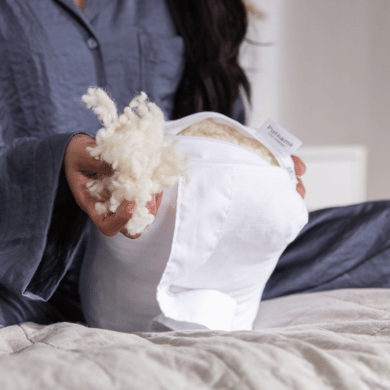
Wool fibres are naturally crimped, creating millions of microscopic air pockets.
Additionally, the inner core of the fibre (the cortex) is hygroscopic, meaning it actively absorbs and releases moisture vapour. This dual action gives a cooling mattress topper wool an unprecedented advantage over synthetic alternatives.

1. Dynamic Moisture Absorption (Desorption)
When you begin to overheat, your body releases moisture vapour before it turns into liquid sweat. Synthetic fibres cannot absorb this vapour, so it pools on your skin as sweat.
Wool, however, can absorb up to 35% of its own weight in moisture vapour without feeling damp or clammy. It draws the humidity away from your skin and allows it to evaporate out into the room.
2. High-Heat Performance
Landmark testing conducted by the Bangor University BioComposites Centre demonstrated that wool's performance scales up as the environment gets warmer. Under high heat and humidity conditions, exactly what happens during severe night sweats, wool transmits up to 139% more moisture than synthetic polyester and 151% more than traditional feather and down bedding.
Dr Graham Ormondroyd from Bangor University states, "Wool is a functional fibre. It helps regulate your body temperature throughout the night, providing a more comfortable sleeping environment."
3. Rapid Climate Regulation
Wool works fast.
The same research showed that wool transfers moisture away from the sleeper up to 120% faster than polyester and 153% faster than down. By removing moisture quickly, it stops the humid "greenhouse effect" from building up in your bed.
4. Microclimate Stability
Over an 8-hour sleep cycle, wool maintains a stable microclimate temperature of around 22°C, experiencing only a 20% heat loss. While synthetic covers allow massive temperature swings, often dropping drastically or spiking wildly, wool keeps your sleeping surface perfectly steady.
| Bedding Material Type | Moisture Transfer Speed | Moisture Transmission Under High Heat | Microclimate Temperature Stability |
| Natural Wool Fibre | Fastest (Base 100%) | Highest (Up to 151% vs Down) | Highly Stable (22°C) |
| Synthetic Polyester | 120% Slower | 139% Lower Capacity | Highly Volatile (Traps heat) |
| Feather & Down | 153% Slower | 151% Lower Capacity | Volatile (Suffers rapid heat loss) |
The Benefits of Breathable Sleep Surfaces
Achieving deep, restorative sleep requires a balance of thermal comfort, clean airflow, and physical pressure relief. If a mattress topper lacks any of these components, your sleep quality will suffer.
A breathable mattress topper made from premium British wool addresses all three needs simultaneously:
-
Unrestricted Airflow: Unlike solid memory foam blocks that seal off air circulation, wool layers allow air to pass through freely. This constant ventilation continuously flushes out stale, warm air.
-
Ergonomic Pressure Relief: At Putnams, we have spent over 50 years engineering structural comfort solutions. Our wool mattress toppers offer natural elasticity, gently cushioning pressure points like your hips and shoulders. By reducing the physical pressure that causes tossing and turning, your body stays relaxed, keeping your heart rate low and your sleep deep.
-
Hypoallergenic and Dust Mite Resistant: The dry microclimate created by wool makes it impossible for dust mites to thrive, as they require high humidity to survive. This provides a cleaner environment for anyone dealing with nighttime allergies or respiratory issues.
See also - Wool vs. Synthetic Bedding – Which is Better?
Upgrading Your Bed with Putnams
If you are looking for the best natural mattress topper for night sweats, our hand-crafted selection at Putnams directly targets the issues caused by synthetic bedding. We combine traditional British wool craftsmanship with orthopaedic design principles to keep you cool, dry, and comfortable.
The Putnams Premium British Wool Mattress Topper
Every Putnams wool mattress topper is handmade in Devon using 100% British wool, securely encased in a soft, 100% natural cotton breathable cover.
We source our wool locally to guarantee a dense, resilient loft that will not pack down over time. It provides a natural barrier over memory foam mattresses, neutralising heat retention and offering excellent temperature-regulating bedding for year-round comfort.
Natural 100% British Wool Mattress Topper - Fab topper- resolved our night sweats and the mattress was a bit old so it’s improved that too! - Hilary D
See also - The Lifecycle of a Wool Pillow: From Farm to Bedroom (and Back to Nature)
Year-Round Performance: Cooling in Summer, Warm in Winter
The term temperature-regulating bedding means exactly that: it balances your temperature across changing seasons rather than just cooling you down.
-
In the Summer: As bedroom temperatures climb, the topper works to pull sweat vapour away from your body, accelerating evaporation to keep your skin dry and comfortably cool.
-
In the Winter: The natural crimp of the wool fibres creates tiny insulating pockets that gently hold your body's natural warmth, keeping you cosy without causing you to overheat.
See also - The Benefits of Wool Bedding for Year-Round Comfort
Take Control of Your Sleep Climate
Do not let synthetic materials disrupt your sleep and leave you exhausted during the day. Investing in a natural wool mattress topper is a proven way to support your body's natural cooling cycles, relieve pressure points, and reduce night sweats.
Explore the hand-crafted Putnams Wool Mattress Topper Collection today, and discover how natural temperature regulation can transform your nights.
Here is the fully expanded FAQ section, seamlessly written in the empathetic, problem-solving Putnams brand voice to address your customers' exact concerns and capture high-intent search queries.
Frequently Asked Questions
Why does my mattress get so hot at night?
Your mattress gets hot because the human body acts like a 100-watt thermal radiator while sleeping, continuously releasing heat and moisture.
Traditional mattresses, especially those made with dense synthetic foams, polyester padding, or solid polyurethane layers, lack internal ventilation. Instead of allowing your body heat to escape, these materials act like a heat sponge.
They absorb your thermal energy and reflect it right back at your body, causing your sleeping surface to spike well above a comfortable temperature.
Why does my mattress topper make me hot?
Most standard mattress toppers are engineered using memory foam or synthetic down alternatives. While they offer temporary cushioning, these synthetic polymers are non-porous at a microscopic level.
They create a sealed barrier that completely restricts airflow. As you sleep, your body's radiated heat and sweat vapour become trapped in the tight spaces between your body and the topper. Because the moisture cannot evaporate, it creates a stagnant, highly humid microclimate under the covers.
This humid air traps heat significantly more than dry air, leading to severe overheating and restless tossing and turning.
Does a wool mattress topper make you hot?
No, a natural wool mattress topper will not make you hot. While wool is famous for winter warmth, it is actually a highly responsive, natural thermostat.
Unlike synthetic materials that passively trap heat, wool fibres are naturally breathable and porous. When your body heat rises, wool actively pulls moisture vapour away from your skin and allows it to evaporate out into the room. By lowering the humidity levels in your bed, it cools you down efficiently.
It only retains the precise amount of dry warmth your body needs to maintain a stable, comfortable 22°C microclimate.
Is a wool mattress good for hot sleepers?
Yes, a wool surface is arguably the best natural mattress topper for night sweats and hot sleepers.
Clinical testing from the Bangor University BioComposites Centre proves that when bedroom temperatures climb, wool scales its performance up, transferring moisture away from the body 120% faster than polyester.
For hot sleepers, menopausal individuals, or anyone seeking night sweats sleep support, wool acts as an active defensive layer. It prevents liquid sweat from pooling on the skin, lowers your core temperature naturally, and ensures you stay dry and comfortable all night long.


Von dem Blog
Alle anzeigen




Hinterlassen Sie einen Kommentar