

Sciatica Pain at Night: Why Sciatic Nerve Pain Intensifies During Sleep
Quick Answer: Sciatica pain at night worsens because lying down causes spinal discs to rehydrate and swell, increasing pressure on the sciatic nerve. Simultaneously, the body's natural anti-inflammatory hormone, cortisol, drops to its lowest levels between midnight and 4 AM, allowing inflammation to build around the nerve. Strategic leg positioning for sciatica, proper lumbar support, and targeted sleep aids can significantly reduce nocturnal flare-ups.
You brush your teeth, turn off the lights, and finally lie down, only for that sharp, burning sensation to begin its all-too-familiar journey from your lower back, through your buttock, and straight down your leg. Sound familiar?
If you find yourself asking "why is my sciatica worse at night?", you are far from alone. According to the British Journal of Anaesthesia, between 13% and 40% of the UK population will experience sciatica at some point in their lifetime. For a significant number of those people, the nights are the hardest part. Research indicates that between 55% and 65% of patients with chronic sciatica experience severe sleep disturbances, compared to roughly 25-30% of the general population.
That statistic matters. When sciatic nerve pain while sleeping interrupts your rest night after night, the resulting sleep deprivation actually lowers your pain threshold, which means the pain you feel the following day becomes more intense. It is a cycle that can feel impossible to escape.
This post breaks down exactly why sciatica is worse at night, what is happening inside your spine after midnight, and, most importantly, what you can do about it tonight.
Why Lying Down Can Aggravate the Sciatic Nerve
To understand sciatic nerve pain while sleeping, you need to understand what happens to your spine the moment you lie down.
Throughout the day, gravity compresses your intervertebral discs, the shock-absorbing cushions between each vertebra. This constant downward force gradually squeezes fluid out of them. When you finally lie flat at night, that gravitational load is removed. Your discs begin to rehydrate, absorbing fluid and expanding slightly. For a healthy spine, this is a completely normal and beneficial recovery process.
However, for anyone with a bulging or herniated disc, one of the most common underlying causes of sciatica, this slight expansion creates a significant problem. The swelling disc takes up more space in the already-narrow spinal canal, pressing harder against the sensitive sciatic nerve root and turning up the dial on your pain precisely when you are trying to sleep.
Beyond disc mechanics, reduced movement overnight also plays a key role. During the day, walking, stretching, and even shifting in your seat all encourage blood flow and gently mobilise the joints and surrounding tissue. When you lie still for hours, that natural circulation slows. Without adequate blood flow to clear inflammatory byproducts from the area, nerve sensitivity increases, and pain sharpens.
Finally, there is a psychological element.
During the day, your brain is occupied with work, conversation, and movement, all of which compete with pain signals for your attention. In a quiet bedroom at 2 AM, with no distractions, your central nervous system amplifies those signals. The same level of nerve irritation that felt manageable at noon can feel unbearable at midnight.
The Role of Spinal Loading and Inflammation Overnight
Two compounding factors drive nocturnal sciatica flare-ups that are often overlooked: unsupportive spinal loading and your body's natural inflammatory rhythm.
What Is Spinal Loading During Sleep?
When you sleep, your muscles relax completely, surrendering spinal support to your mattress and your sleeping position. If your mattress is too soft, your pelvis sinks and your lower back bows. If it is too firm, pressure concentrates on bony prominences and forces your spine into unnatural curves. Either scenario is what biomechanists refer to as poor spinal loading.
When the lower back arches excessively or the hips twist, in unsupported side sleeping, pressure builds specifically on the L4, L5, and S1 vertebral levels. These are the exact nerve roots that form the sciatic nerve. Sustained compression here translates directly into the burning, electric-shock sensations that shoot down the leg.
The Midnight Inflammation Peak
Cortisol is the body's primary anti-inflammatory hormone. According to research published by Harvard Health Publishing, cortisol levels drop to their absolute lowest between midnight and 4 AM. During this window, the body's natural defences against inflammation are effectively reduced, allowing inflammatory chemicals to accumulate around the sciatic nerve. Combined with the decreased blood flow from lying still, this creates a perfect storm for pain, which is why sciatica is often worse at night and in the early hours of the morning specifically.
According to a clinical study cited by Harley Street Specialist Hospital, 77% of a sample of 466 sciatica patients reported sleeping problems, compared to just 30% of the general population.
What Are the Best Sleeping Positions for Sciatica Pain Relief?
The most effective immediate action you can take is to adjust your sleep posture. Strategic leg positioning for sciatica can actively unload the lumbar discs, open up the nerve exit points in the spine, and prevent muscles from clamping down on the sciatic nerve.
|
Sleep Position |
The Problem |
The Fix |
|---|---|---|
|
Back sleeping |
Flat legs force the lower back into an exaggerated arch |
Elevate the knees to tilt the pelvis and flatten the lumbar spine |
|
Side sleeping |
Top knee drops forward, rotating the pelvis and irritating the piriformis muscle |
Place a firm pillow between the knees to keep the hips stacked |
|
Stomach sleeping |
Forces the lumbar spine into hyperextension, compressing the posterior disc space |
Discouraged; if unavoidable, place a flat pillow under the pelvis |
How Does Elevating Your Legs Help Sciatica Pain at Night?
For back sleepers, placing a supportive wedge or firm pillow under the knees is highly effective. Allowing the knees to bend slightly tilts the pelvis backwards, which flattens the lower back against the mattress. This directly unloads the L4, L5, and S1 nerve roots, the precise origin points of the sciatic nerve, reducing the tension that produces nighttime pain.
How Should a Side Sleeper Position Their Legs for Sciatica?
Without support, the top knee drops forward and pulls the upper hip out of alignment, rotating the pelvis and stretching the piriformis muscle deep in the buttock. Because the sciatic nerve runs directly beneath (and sometimes through) the piriformis, tension there translates instantly into radiating leg pain. Placing a firm, contoured pillow between the knees and thighs keeps the hips stacked neutrally and removes that rotational stress from the nerve.
Many patients notice meaningful relief within just a few nights of making this adjustment.
How Putnams Support Pillows Can Help Relieve Sciatic Nerve Pain in Bed
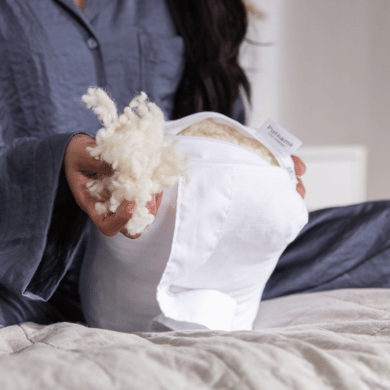
The right support pillow makes the difference between a restless night and a genuinely restorative one. Putnams has been handcrafting specialist comfort products in Devon since 1979, and our range includes several options particularly well-suited to sciatica pain at night.
For side sleepers, the Putnams Knee Pillow – Side Sleeper with Adjustable Strap is contoured to fit between the legs precisely, maintaining hip neutrality without shifting during the night. The Memory Foam Knee Pillow offers a firmer, more adaptive option that conforms to your specific anatomy.
For back sleepers, the Leg Rest – Leg Raiser provides consistent, stable elevation under the knees, keeping the lumbar spine decompressed throughout the night far more reliably than loose pillows that shift as you move. The Memory Foam Leg Rest adds a contouring layer for additional comfort.
For broader back support, the Bed Back Support Pillow a D-shaped firm pillow designed to sit under the small of the back, helps maintain the natural lumbar curve during sleep, particularly useful for those who find a gap between their lower back and the mattress in any position.
A quick reference guide:
|
Putnams Product |
Best For |
Options |
|---|---|---|
|
Side sleepers |
Memory Foam, Wool & Buckwheat |
|
|
Side & back sleepers |
Foam |
|
|
Back sleepers |
Memory Foam |
|
| Sports Recovery Pillow |
Side sleepers |
Original |
| Lumbar Gap Support | Foam |
Pre-Bed Habits That Can Calm the Sciatic Nerve
Positioning is crucial, but preparing the body before bed can determine how the entire night unfolds.
- Apply heat before lying down. A warm bath or a 15-20 minute heating pad session on the lower back before bed relaxes the tight muscles surrounding the sciatic nerve, improves local blood flow, and flushes out some of the inflammatory markers that accumulate with inactivity. Avoid falling asleep with a heated pad in place.
- Gentle nerve glides. Simple mobilisation exercises, such as seated nerve glides and gentle figure-four stretches targeting the piriformis, performed slowly before bed can prevent the nerve from becoming "stuck" in compressed tissue overnight. If any movement produces a sharp "zing," reduce the range and consult a healthcare professional.
- Break up prolonged sitting in the evening. Prolonged sitting allows the hips to tighten and the discs to compress. Aim to stand and move briefly every 30-45 minutes in the hours before bed to maintain blood flow and reduce the stiffness that worsens sciatic nerve pain while sleeping.
- Check your mattress. A mattress that is too soft allows the pelvis to sink into a "hammock" position, disastrous for the sciatic nerve. Research reviewed by Harvard Health Publishing suggests a medium-firm mattress is generally optimal for maintaining spinal alignment and reducing lower back pain.
When Should You See a Doctor About Nighttime Sciatica?
For many people, sciatica pain at night improves with the strategies above within a few weeks. However, certain symptoms require prompt medical attention.
Seek immediate care, including A&E if necessary, as advised by the NHS, if you experience:
- Sciatica on both sides simultaneously
- Progressive weakness or numbness in one or both legs
- Numbness around the genitals or anus
- Difficulty controlling bladder or bowel function
These can indicate cauda equina syndrome, a medical emergency. Do not wait.
For persistent pain that does not improve after a few weeks of home management, or symptoms that are worsening, speak to your GP. Physiotherapy, targeted stretching programmes, and in some cases pain relief injections are all available options.

Frequently Asked Questions
Why does sciatica always feel worse at night?
Sciatica is worse at night for three overlapping reasons: the spinal discs rehydrate and expand when you lie down, increasing pressure on the sciatic nerve; the anti-inflammatory hormone cortisol drops to its lowest levels between midnight and 4 AM, allowing inflammation to build; and the absence of daytime distractions means your brain focuses entirely on incoming pain signals.
What is the best sleeping position for sciatica pain?
The best sleeping position for sciatica pain is either on your back with a firm pillow or wedge under the knees, or on your side (preferably the pain-free side) with a firm pillow between the knees. Both positions reduce the rotational stress on the lumbar spine and limit compression of the sciatic nerve roots.
Can the wrong mattress make sciatica worse at night?
Yes. A mattress that is too soft allows the pelvis to sink unevenly, creating a "hammock" effect that places sustained pressure on the lumbar discs and sciatic nerve roots. A mattress that is too firm creates hard pressure points at the hips and shoulders. Medium-firm mattresses are generally recommended for those managing lower back and nerve pain.
Does a knee pillow actually help sciatica?
A knee pillow can be highly effective for sciatica pain while sleeping, particularly for side sleepers. By preventing the top leg from dropping forward, a contoured knee pillow keeps the pelvis in a neutral position, removes rotational stress from the lumbar spine, and reduces tension in the piriformis muscle, a frequent contributor to sciatic nerve compression.
How long does nighttime sciatica typically last?
According to the NHS, sciatica usually improves within a few weeks to a few months. However, cases linked to underlying conditions such as a herniated disc, spinal stenosis, or degenerative disc disease may take longer and benefit from professional treatment. If symptoms persist beyond several weeks or are worsening, consult your GP.
Small Changes, Meaningful Nights
Sciatica pain at night is genuinely exhausting, physically and mentally. But understanding the mechanics of why it happens empowers you to act. Disc rehydration, the cortisol dip, poor spinal loading, and unmanaged nerve compression during sleep are all factors you can address directly, tonight.
Strategic positioning with a quality knee pillow or leg raiser, a pre-bed heat routine, and the right mattress firmness can each make a measurable difference. Combined, they give the sciatic nerve the space it needs to settle, and give you back the deep, restorative sleep your body depends on.
Explore the full range of lumbar support and leg positioning products at Putnams, all handmade in Devon and designed with over four decades of comfort expertise.


Von dem Blog
Alle anzeigen




Hinterlassen Sie einen Kommentar