

Rib and Chest Wall Pain When Lying Down: Understanding Costochondritis at Night
Quick answer: Costochondritis causes rib pain at night because lying flat compresses the front of the chest whilst restricting the back of the rib cage, straining the inflamed cartilage joining your ribs to your sternum. Elevating the torso 15–30 degrees with a wedge pillow, sleeping on your unaffected side with support, and practising diaphragmatic breathing can significantly ease chest pain lying down and improve sleep quality.
Waking at 2 am with a sharp, aching sensation across your chest can be frightening. For the many adults who have already visited their GP or A&E, only to be reassured their heart is perfectly healthy, the sudden flare-up of chest pain lying down remains a genuinely frustrating experience. You settle in to rest, yet within minutes your sternum feels bruised, your ribs throb, and taking a deep breath becomes painful.
If this sounds familiar, you're likely dealing with costochondritis, an inflammatory musculoskeletal condition affecting the chest wall.
According to the NHS, this pain is often worse when lying down, moving your upper body, or breathing deeply. It's non-life-threatening, but rib pain at night can disrupt deep sleep, trigger anxiety about your symptoms, and leave you thoroughly exhausted the next day.
Understanding why does my chest hurt more when I lie down is the first step towards reclaiming restorative sleep. By unpicking the mechanical tension that flat lying places on your rib cage, and making targeted adjustments to your posture, breathing, and support systems, you can ease nighttime discomfort considerably.
What Is Costochondritis? The Anatomy Behind Nocturnal Flare-Ups
To understand why costochondritis pain sleeping can feel so severe, it helps to look at how your rib cage is built. Your chest wall is a flexible cage designed to protect your vital organs whilst expanding and contracting thousands of times a day.
Your ribs don't attach directly to the hard bone of your breastbone (sternum). Instead, strips of dense, rubbery connective tissue called costal cartilage join the ribs to the sternum at the costochondral junctions. When these cartilage segments become inflamed, even small stresses create sharp or burning, localised pain.
The data on this condition is more common than most people realise:
|
Source |
Finding |
|---|---|
|
Costochondritis occurs in 4% to 50% of patients presenting with chest pain |
|
|
Accounts for 13% to 30% of non-cardiac chest pain presentations |
|
|
Around one-third of people visiting a healthcare provider with chest or rib pain have costochondritis |
|
|
Primarily affects the 2nd to 5th costochondral junctions |
|
|
Over 90% of patients improve within 3-4 weeks with conservative treatment |
|
|
Happens most often in women over age 40 |
Unlike cardiac pain, which often radiates broadly and comes with systemic symptoms like sweating or nausea, costochondritis pain is distinctly musculoskeletal. It's characteristically reproducible when you press directly on the affected rib joints, or when your upper body twists and compresses.
During the day, an upright posture and constant micro-movements distribute physical forces across your whole spine and rib cage. But once you lie down for the night, those gravitational dynamics shift dramatically, which brings us to the heart of the problem.
Why Flat Positions Increase Chest Wall Pressure
Many patients ask a similar question during physiotherapy appointments: why does sternum pain when lying flat feel significantly worse than when standing? The answer lies in thoracic biomechanics and gravitational compression.
- Anterior stretch and posterior restriction. When you lie flat, the back of your rib cage presses firmly against the mattress. This restricts the natural backward movement of your posterior costovertebral joints (where the ribs meet the spine). To compensate during breathing, the front of your chest, where the inflamed cartilage sits, bears an increased workload, stretching the sensitive sternocostal joints.
- Shoulder collapse and anterior compression. For side sleepers, sleeping without proper chest wall pain support is often the main culprit behind midnight awakenings. Without support, your upper shoulder slumps forward and inward, collapsing the chest and pinching the inflamed cartilage between the rib heads.
- Reduced overnight recovery. The NHS notes that pain from costochondritis characteristically worsens when lying down flat, in part due to thoracic alignment pressure building overnight without the postural changes you'd naturally make during waking hours.
Understanding this mechanical picture matters, because it points directly to the solution: reducing the compression and twist that flat lying places on your chest wall.
The Breathing and Pain Connection Overnight
Breathing isn't optional, even when your chest wall hurts.
The average adult takes between 12 and 20 breaths per minute, nearly 5,000 breaths across an 8-hour sleep cycle. Every single one requires the costal cartilage to flex and rotate slightly.
As you transition into sleep, your respiration naturally shifts:
- Shallow thoracic breathing. During non-REM sleep, breathing becomes slower and shallower. If your chest muscles are tense from guarding against pain during the day, nighttime breathing patterns can lock these muscles in a shortened, strained state.
- Deep breathing in REM sleep. During REM phases, breathing becomes irregular and occasionally deeper. A sudden chest expansion can stretch inflamed cartilage abruptly, triggering a sharp pain reflex that jolts you awake.
- Diaphragmatic restriction. Lying flat compresses the abdominal contents upward against the diaphragm, forcing your upper intercostal muscles to work harder to lift the rib cage, exacerbating rib pain at night.
Learning how to relieve rib cage pain at night requires interrupting this cycle of muscle guarding, restricted joint movement, and sleep disruption. Position is the most powerful lever you have.

Best Sleeping Position for Costochondritis: Using Incline and Support
If you're navigating sleeping position costochondritis challenges, shifting from flat sleeping to a supportive, semi-inclined setup can offer meaningful relief.
|
Sleep Position |
Impact on Costochondritis |
Recommended Adjustment |
|---|---|---|
|
Flat back (supine) |
High pressure, stretches the anterior chest wall and restricts posterior rib movement |
Elevate the torso 15-30 degrees; place a pillow under the knees |
|
Unsupported side |
Very high pressure, rotates the sternum and collapses the upper shoulder inward |
Hug a thick pillow to keep shoulders open; place a firm pillow between the knees |
|
Stomach (prone) |
Extreme pressure, directly compresses the sternum and twists the cervical spine |
Avoid entirely during acute flare-ups |
The inclined back position
The single best sleeping position for costochondritis is resting on your back, elevated at a 15 to 30-degree incline. This is where a dedicated wedge pillow earns its keep, rather than relying on stacked, sliding pillows that lose their angle by 3am.
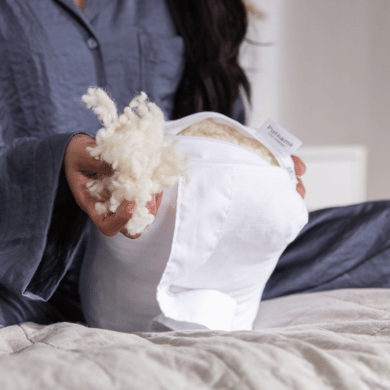
Our Anti-Snoring Bed Wedge Pillow, for example, is built to a 6" (15.2cm) height, a design decision informed by research showing meaningful symptom relief at this elevation. It's suitable for both back and side sleepers, and comes in Standard, Memory Foam, or cooling Graphite Latex options, so you can match the support to your preferred feel. It's also handmade in Devon and backed by a 2-year guarantee, with a washable cover for easy care.
By elevating your upper body:
- You reduce the upward abdominal pressure on your diaphragm.
- Gravity assists your inhalation, reducing intercostal muscle strain.
- The tension across your sternum eases as your shoulders settle naturally backward.
A small but useful tip: place a pillow under your knees while elevated. This tilts your pelvis slightly, taking pressure off your lower back and stopping you sliding down the wedge overnight.
The hugged-pillow side position
If back sleeping simply isn't for you, side sleeping requires firmer structural support:
- Sleep on your unaffected side whenever possible.
- Hug a firm, thick pillow tightly against your chest with your upper arm. This acts as a physical prop, holding your top shoulder up and stopping it rolling forward onto your sternum.
- Place a supportive pillow between your knees to keep your hips and spine aligned, preventing rotational twist through the mid-back.
A Bed Back Support Pillow can also help here, its D-shaped, firm design sits behind the lower back to maintain the spine's natural curve, which takes some of the compensatory strain off the upper chest wall.
See also - Mastering the Art of a Restful Night's Sleep: How to Sleep Better in 8 Easy Steps
A Step-by-Step Nighttime Relief Routine
A simple four-step evening routine can help prepare your chest wall for a more comfortable night:
- Apply moist heat or ice before bed. Fifteen to twenty minutes before sleep, apply a moist heating pad on low heat to the back of your upper shoulders and thoracic spine to relax guarding muscles. If the sternum area feels warm and acutely inflamed, apply a cloth-wrapped ice pack directly over it for 10-15 minutes instead.
- Perform gentle thoracic extensions. Sit upright, roll a towel horizontally behind your mid-back, and lean gently backward over it whilst breathing out softly. This mobilises stiff posterior rib joints, relieving the burden on your anterior cartilage. Never force through pain.
- Practise diaphragmatic "belly" breathing. Once positioned on your wedge, place one hand on your stomach and one on your chest. Inhale slowly through your nose so only your abdomen rises, keeping your chest still. This lets your lungs fill without expanding the inflamed costal joints.
- Set up your ergonomic support props. Position your wedge pillow and any supporting cushions firmly before drifting off, ensuring your neck stays in a neutral plane so your upper trapezius and chest muscles remain relaxed throughout the night.
See also - Knee Pain at Night: Why Sleep Position Strains the Joint
When to Consult Your Doctor
Whilst costochondritis is a benign condition, chest pain lying down should never be dismissed if it's new, changing, or accompanied by red-flag symptoms.
Seek immediate medical attention if your chest pain comes with:
- Shortness of breath, dizziness, or lightheadedness
- Pain radiating to your neck, jaw, left shoulder, or arm
- Sweating, fever, nausea, or a sense of crushing pressure
- A sudden, sharp onset following a traumatic injury
If cardiac and respiratory causes have been safely ruled out by your GP, working alongside a physiotherapist or osteopath can help correct underlying thoracic joint stiffness, so you can sleep peacefully without fear of the next flare-up.
See also - Sleep and Joint Health: Why Stiffness Starts at Night
Frequently Asked Questions
Why does my chest hurt more when I lie down?
Lying flat presses the back of your rib cage against the mattress, restricting posterior rib movement. Your anterior chest wall then has to compensate during breathing, which stretches the inflamed costochondral joints and intensifies pain.
What is the best sleeping position for costochondritis?
Sleeping on your back with your torso elevated 15-30 degrees is generally best, as it reduces pressure on the chest wall and eases breathing. If you prefer side sleeping, lie on your unaffected side and hug a firm pillow to your chest for support.
How long does costochondritis last?
According to StatPearls, over 90% of patients see symptomatic improvement within 3-4 weeks. The NHS notes it can take anywhere from a few weeks to several months to resolve fully.
Can a wedge pillow really help with rib pain at night?
Yes. A wedge pillow maintains a consistent incline throughout the night, which stacked pillows rarely manage. This reduces diaphragmatic pressure and eases the anterior chest wall tension that builds when lying flat.
When should I worry that my chest pain isn't costochondritis?
See a doctor urgently if pain radiates to your arm, neck, or jaw, or is accompanied by breathlessness, sweating, or a crushing sensation; these can indicate a cardiac or other serious cause and need immediate assessment.


Von dem Blog
Alle anzeigen




Hinterlassen Sie einen Kommentar