

Restless Legs at Night: Why Legs Feel Restless Sleeping and How to Settle Them
Quick answer: Restless legs at night worsen due to a natural evening drop in dopamine levels (by up to 30%), reduced leg circulation when lying still, and heightened nerve sensitivity driven by your body's circadian rhythm. Practical relief includes leg elevation for sleep, knee support pillows, and pre-bedtime stretching, all of which address the mechanical and neurological triggers behind RLS symptoms at night.
You settle into bed after a long day, pull up the covers, and prepare for a peaceful night. Then, just as your mind begins to quiet, an unsettling sensation takes hold in your lower limbs: a prickle, a pull, a relentless crawling deep within your calves. You shift position, kick your feet, get up to walk around, and the relief lasts only until you lie back down.
If this sounds familiar, you are far from alone. According to the Journal of Sleep Research, restless leg syndrome sleep disruption affects approximately 5-10% of adults in Western countries. The NHS confirms that RLS symptoms are consistently worse at night when resting, and the condition can seriously affect sleep quality and overall wellbeing. In the UK, prevalence is estimated at 3-15% of the population, with a slightly higher incidence in women (Leicester, Leicestershire and Rutland ICB).
Understanding why do my legs feel restless when I lie down is the first step toward reclaiming calm, uninterrupted sleep. This guide explores the neurology, circulatory dynamics, and physical positioning factors that drive restless legs at night, and details practical strategies that genuinely help.
Why Does Restless Legs Syndrome Peak in the Evening?
One of the defining features of restless leg syndrome sleep disruption is its strict circadian timing. Symptoms that are manageable during the day often become overwhelming between 6 PM and 10 PM. The explanation lies within the brain's neurochemistry and your body's natural biological rhythms.
How does the dopamine drop trigger RLS symptoms at night?
At the centre of RLS symptoms night episodes is dopamine, the neurotransmitter responsible for smooth motor control, muscle coordination, and sensory signal filtering. Research published in the Journal of Sleep Medicine shows that dopamine activity follows a clear diurnal rhythm, peaking in the morning and declining by up to 30% in the late evening.
In people with restless legs syndrome, the basal ganglia, the brain structures controlling movement, exhibit impaired dopaminergic signalling. When dopamine hits its evening trough, the central nervous system loses its ability to properly suppress sensory signals from the legs, leading to hyperactive motor reflexes and that irresistible urge to move.
Brain iron deficiency compounds this effect. The National Institute of Neurological Disorders and Stroke (NINDS) confirms that low iron within the substantia nigra, a key region for dopamine production, reduces nighttime dopamine synthesis further. This is why the NHS recommends iron testing as a core part of any restless leg syndrome investigation.
What other biological changes worsen RLS at night?
As evening approaches, several physiological shifts converge to heighten leg circulation sleep problems and nerve sensitivity:
|
Evening Biological Change |
Time of Onset |
Effect on RLS |
|---|---|---|
|
Dopamine levels begin to decline |
From 6:00 PM |
Reduced motor signal suppression |
|
Core body temperature rises |
From 7:00 PM |
Triggers sensory discomfort in many sufferers |
|
Cortisol levels drop significantly |
From 8:00 PM |
Reduces natural inflammation control |
|
Melatonin production increases |
From 9:00 PM |
Can paradoxically worsen RLS in some people |
|
Peak RLS symptom onset window |
From 10:00 PM |
Highest likelihood of severe discomfort |
(Source: circadian RLS research, Frontiers in Neurology, 2023; Therapulse clinical data)
Research published in Frontiers in Neurology (2023) confirms that RLS symptoms worsen later in the day due to genuine circadian biology, not simply because sufferers are sitting or lying down.
See also - Restless Legs at Bedtime: The Hidden Role of Sleep Position
The Circulation and Muscle Fatigue Connection
Restless leg syndrome sleep disruption isn't purely neurological. Vascular health and physical exhaustion play a major secondary role in amplifying restless legs at night.
Why does leg circulation drop when you lie down?
Throughout the day, walking and standing engage the calf muscle pump; each contraction propels blood upward toward the heart. The moment you lie flat in bed, this mechanism stops. For people with sluggish venous return, blood can pool in the deep venous plexus of the calves and feet.
This venous stagnation alters local tissue pressure and reduces oxygen delivery to peripheral nerves. Hypersensitive nerve endings, already compromised by the evening dopamine dip, register this circulatory slump as an irresistible urge to move. Research into venous insufficiency and leg circulation sleep problems highlights a significant correlation: clinical findings have reported an 85.9% resolution of restless legs sleep symptoms in patients who received treatment for underlying venous reflux (PMC, 2024).
How does muscle fatigue worsen restless legs when trying to sleep?
A full day of standing, walking, or remaining seated causes micro-inflammatory byproducts, including lactic acid, to accumulate within muscle fibres. When you finally lie down, the abrupt shift from motion to immobility leaves these metabolic byproducts lingering in tired tissues. The combination of muscular tightness, slowed microcirculation, and neurological hypersensitivity creates a powerful environment for restless legs when trying to sleep.
See also - Hip Pain When Sleeping on Your Side: Why Pressure Points Disrupt Rest
Supportive Positioning to Calm Restless Legs
If you are looking for how to stop restless legs at night naturally, ergonomic adjustments offer a highly effective, non-pharmacological first line of defence. Improving spinal alignment, optimising blood flow, and providing targeted support can significantly reduce nightly symptom severity.
What is the best sleep position for restless leg syndrome?
Sleep posture directly impacts lumbar alignment, sciatic nerve tension, and peripheral circulation. Here is a quick reference guide:
|
Sleep Position |
Effect on RLS |
Recommended Support |
|---|---|---|
|
Side sleeping with knee support |
Reduces sciatic nerve tension and hip rotation |
Knee pillow between the legs |
|
Back sleeping with leg elevation |
Improves venous return, reduces pressure |
Leg rest or wedge under calves |
|
Stomach sleeping |
Shortens calf muscles, increases cramp risk |
Not recommended for RLS sufferers |
|
Side sleeping without support |
Can cause "knee-knock" and pelvis misalignment |
Add a memory foam knee pillow |
How does leg elevation for sleep help restless legs?
Leg elevation for sleep is one of the most effective mechanical strategies for easing lower-limb pressure. Elevating your feet 6 to 8 inches above the level of your heart uses gravity to encourage venous blood flow back toward central circulation. Accelerated venous drainage reduces vascular pressure in the lower legs, improves localised capillary oxygenation, and alleviates the heavy, throbbing sensation that frequently accompanies RLS symptoms at night.
Stacking ordinary pillows rarely works; they compress, shift, and create uneven pressure points. The Putnams Leg Rest / Leg Raiser is specifically contoured to support the calves and knees at the optimal elevation height, allowing the calf muscles to fully disengage rather than working to maintain an unstable position. A Memory Foam Leg Rest offers the same benefit with contouring support that adjusts gently to the shape of your limbs.
Why does a knee pillow help restless legs in side sleepers?
Side sleeping is widely considered the best sleep position for restless leg syndrome, but only when the hips and pelvis are properly aligned. When the top leg falls forward, it rotates the pelvis and stretches the sciatic nerve, creating persistent irritation that the brain interprets as discomfort, forcing constant position changes through the night.
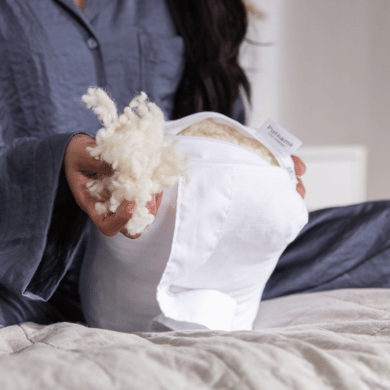
Placing a Knee Pillow with Adjustable Strap between the legs instantly aligns the hips, pelvis, and lumbar spine. This single adjustment removes the nerve tension that so often makes legs restless when trying to sleep. For those who prefer natural materials, the Natural British Wool Knee Pillow and Organic Buckwheat Hulls Knee Pillow offer the same postural benefit with eco-conscious materials, all handmade in Devon.
Can a bed wedge help with restless legs at night?
A Putnams Bed Wedge used beneath the legs creates a gradual, stable incline that standard pillows cannot maintain throughout the night. Unlike stacked pillows, a wedge holds its angle consistently, supporting venous return and reducing that heavy, agitated feeling that drives restless legs at night. The Heel Lift Leg Pillow is another targeted option, particularly useful for those who experience pressure and discomfort concentrated around the heels and ankles.

Lifestyle Habits That Support Calmer Nights
Postural support works best when paired with consistent lifestyle adjustments. The NHS and Cleveland Clinic both recommend the following for managing restless leg syndrome sleep disruption:
Do:
- Exercise moderately during the day; regular exercisers are 3.3 times less likely to have RLS than non-exercisers (RLS Foundation)
- Perform gentle calf and hamstring stretches 1-2 hours before bed
- Try a warm bath with Epsom salts before bedtime to stimulate micro-vascular circulation
- Maintain a consistent sleep and wake schedule
- Keep the bedroom cool (around 18-20°C) to prevent core body temperature spikes that worsen RLS symptoms
Avoid:
- Caffeine after 2:00 PM
- Alcohol within 2-4 hours of bedtime
- Large meals or strenuous exercise late at night
- Sitting still for extended periods in the evening
- Screen use immediately before bed
If persistent restless legs at night continue despite these adjustments, a GP appointment is recommended. The NHS advises that iron deficiency anaemia, kidney disease, and certain medications are all associated with secondary RLS; a blood test checking serum ferritin levels is a standard first step.
See also - The Science of Sleep: How Understanding Your Sleep Cycle Can Improve Your Health
Reclaim Calm, Uninterrupted Sleep
Restless legs at night are the result of a complex physiological interaction: evening dopamine fluctuations, slowed leg circulation sleep mechanics, muscle fatigue, and heightened nerve sensitivity all converge at the worst possible moment. The irresistible urge to move is not imaginary. It is the body's response to real, measurable biological changes.
The good news: targeted support can make a meaningful difference. By combining an understanding of your body's circadian clock with practical ergonomic strategies, leg elevation for sleep, proper knee alignment, and structured cushioning support, you can reduce nightly symptom severity without medication.
Explore our full Legs and Feet collection, handmade in Devon and trusted by thousands of customers across the UK. Every product is designed to deliver lasting comfort, because restful nights should not be the exception.
See also - Sciatica Pain at Night: Why Sciatic Nerve Pain Intensifies During Sleep
Frequently Asked Questions About Restless Legs at Night
Why do my legs feel restless when I lie down but not during the day?
Restless legs at night worsen due to your body's circadian rhythm.
Dopamine levels fall by up to 30% in the evening, reducing the brain's ability to suppress abnormal sensory signals from the legs. At the same time, lying flat stops the calf muscle pump, causing leg circulation sleep to slow and blood to pool in the lower limbs. These two factors combine to produce the irresistible urge to move that is characteristic of RLS symptoms at night.
What is the best sleep position for restless leg syndrome?
Side sleeping with a knee pillow between the legs is widely considered the best sleep position for restless leg syndrome. It keeps the hips, pelvis, and lumbar spine neutrally aligned, reducing sciatic nerve tension. Back sleeping with the legs elevated 6–8 inches using a leg rest or wedge is also effective for improving venous return and reducing pressure in the lower limbs.
How does leg elevation for sleep reduce restless leg symptoms?
Leg elevation for sleep uses gravity to encourage blood to flow back toward the heart from the lower limbs. This reduces venous pooling, lowers local tissue pressure, and improves oxygen delivery to peripheral nerves, directly addressing one of the key circulatory triggers of restless leg syndrome sleep disruption. A contoured leg rest or wedge pillow is more effective than stacked pillows, which compress and shift overnight.
How to stop restless legs at night naturally without medication?
How to stop restless legs at night naturally involves several evidence-based strategies: elevate the legs during sleep, use a knee pillow to maintain spinal and hip alignment, stretch the calves and hamstrings before bed, avoid caffeine after midday, limit alcohol, and keep the bedroom cool. If symptoms persist, speak to a GP to rule out iron deficiency, a common and treatable contributor to restless legs at night.
When should I see a GP about restless legs at night?
The NHS recommends seeing a GP if restless legs at night are stopping you from sleeping, affecting your mental health, or failing to respond to self-care strategies. A GP can check your iron (ferritin) levels, review your current medications, some of which can worsen RLS symptoms, and discuss further treatment options if needed.


Von dem Blog
Alle anzeigen




Hinterlassen Sie einen Kommentar